Hair Transplant vs Hair Regrowth Treatment in Kota Kinabalu: Which Works for You?

Dr. Lu Ying Shean
Founder, MU Scalp & Hair Growth Solutions
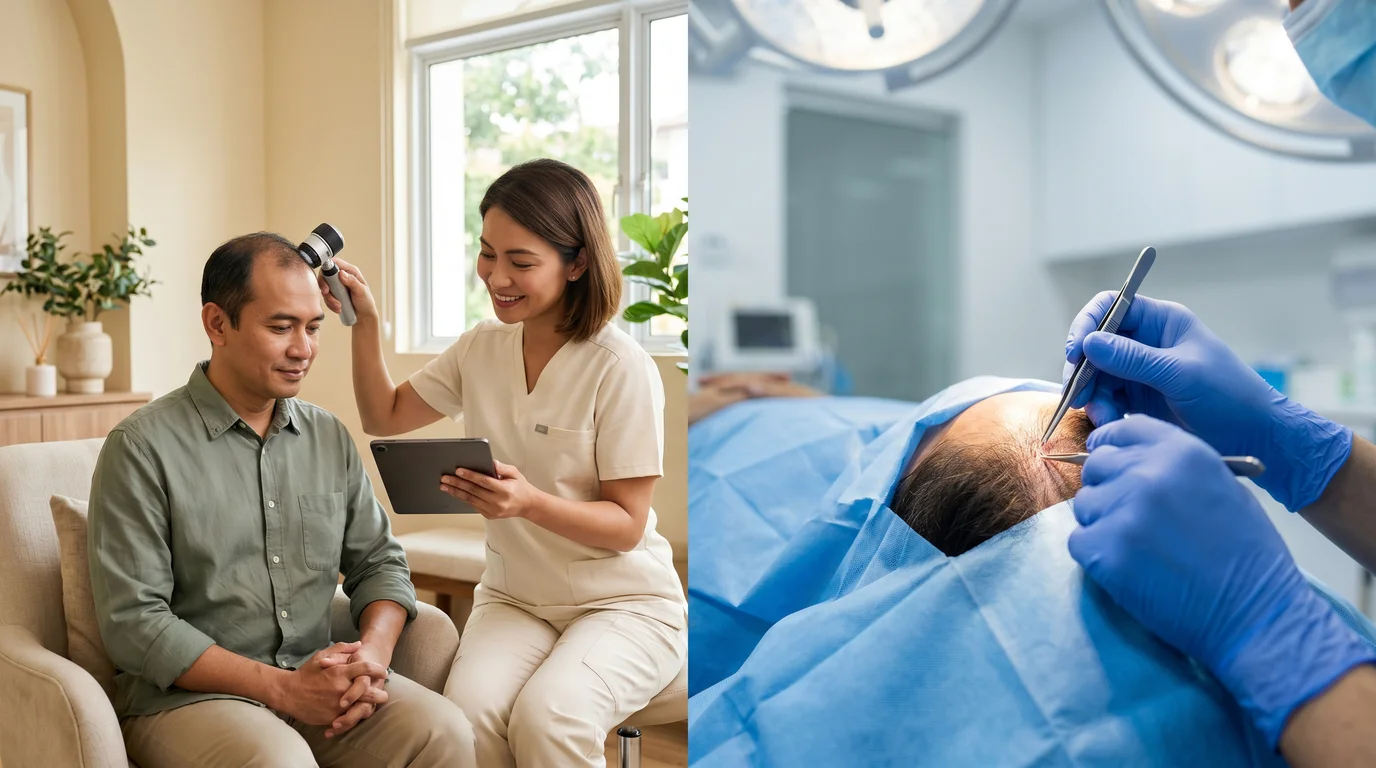
If you’ve been searching for a hair transplant in Kota Kinabalu, you’ve probably noticed something: there aren’t many local options, the prices are high, and the timeline from consultation to result spans months. Before you book a flight to KL or commit RM20,000-50,000 to a surgical procedure, it’s worth understanding the alternative — and when each path actually makes sense.
At MU Scalp, we don’t perform hair transplants — and for most patients we see in Kota Kinabalu, that’s actually the better path. We’re a hair growth centre, not a surgical clinic. Our focus is reviving the follicles you still have, using non-surgical medically-guided protocols, before they die. Below is how that decision compares to surgery — and when each path genuinely makes sense.
This guide compares hair transplant surgery and medically-guided hair regrowth treatment, the way Dr. Lu Ying Shean explains it to patients during consultations at MU Scalp. Both have a place. Neither is universally “better.” The right choice depends on your stage of hair loss, your goals, and how willing you are to wait for results that may take months to appear.
What’s the difference between a hair transplant and hair regrowth treatment?
A hair transplant is a surgical procedure that physically relocates healthy hair follicles from the back/sides of the scalp to areas where hair has thinned or stopped growing. Hair regrowth treatment is a non-surgical, ongoing medical protocol that uses topical, oral, or injection-based therapies to revive weakened follicles and slow the underlying cause of hair loss.
Transplants address the visible result. Regrowth treatments address the underlying cause. They aim at different problems.
The most common misunderstanding is treating them as alternatives — as if one replaces the other. In practice, regrowth treatment is what you should try first when your follicles are still alive and producing hair (even weakly). A transplant is appropriate when follicles in a specific area have died and stopped producing entirely. The two work in different windows of the hair loss timeline.
How does hair transplant surgery work — and what does it cost in Malaysia?
Hair transplant surgery in Malaysia is performed using one of two techniques: Follicular Unit Extraction (FUE) or Follicular Unit Transplantation (FUT, also called the strip method). Both involve removing healthy hair follicles from a “donor area” — usually the back of the head — and surgically implanting them into the thinning or bald “recipient area.”
FUE is the modern standard. A surgeon uses a small punch tool to extract individual follicular units (groups of 1-4 hairs) from the donor area, one at a time. These are then implanted into tiny incisions made in the recipient area. A typical session implants 1,500-3,500 grafts and takes 6-10 hours.
FUT involves removing a strip of scalp from the donor area, dissecting it into individual grafts under a microscope, and implanting them. FUT leaves a linear scar in the donor area but allows for larger graft counts in a single session.
Cost in Malaysia (2026 ranges):
- FUE in Kuala Lumpur: RM12,000-30,000 for 1,500-3,000 grafts (typical men’s hairline restoration)
- FUE in private Singapore clinics: RM45,000-80,000 equivalent
- FUT in KL: RM8,000-22,000 (less popular due to visible scar)
- Add 20-30% for famous surgeons or international clinics in Malaysia
There is currently no full-service hair transplant surgeon practising in Kota Kinabalu. Most Sabahans considering a transplant fly to Kuala Lumpur or, less commonly, Bangkok or Istanbul. Add flights, accommodation, and follow-up visits to your total cost — typically RM2,000-5,000 in additional travel expense.
What recovery looks like: Tiny scabs and redness for 7-14 days post-procedure. Transplanted hairs shed within 2-4 weeks (this is normal — the follicles survive). New growth from the transplanted follicles starts visibly at 3-4 months. Final results appear at 12-18 months.
Important caveat: A transplant does NOT stop the underlying cause of hair loss in your original (non-transplanted) hair. If you have androgenetic alopecia, your non-transplanted hair will continue to thin around the new transplants — sometimes creating an unnatural “island” of dense hair surrounded by ongoing thinning. This is why surgeons commonly prescribe regrowth treatments (finasteride, minoxidil) for life after a transplant.
How does medically-guided hair regrowth treatment work?
Medically-guided hair regrowth treatment is a non-surgical protocol designed to diagnose the cause of your hair loss, treat the underlying biology, and revive weakened follicles before they die. It’s an ongoing programme — typically 6-12 months for initial results, with maintenance treatments to preserve them.
At MU Scalp in Kota Kinabalu, a regrowth treatment plan begins with a thorough scalp analysis and diagnosis. We identify whether your hair loss is androgenetic (genetic pattern), telogen effluvium (stress-related shedding), nutritional, hormonal, or scalp-condition-driven — because the right treatment depends on the right cause.
Depending on diagnosis, treatment plans may include:
- Topical follicle-stimulating serums (minoxidil and related compounds) — applied daily, work by extending the active growth phase of follicles
- Oral medications (finasteride for men, hormonal adjustments for women where appropriate) — address hormonal causes of pattern hair loss
- Scalp PRP or growth factor therapy — injections of platelet-rich plasma or growth factor concentrates that stimulate dormant follicles
- Mesotherapy — micro-injections of vitamins, minerals, and growth factors directly into the scalp
- Low-level laser therapy (LLLT) — light-based stimulation of follicles
- Nutritional support — addressing iron, vitamin D, biotin, zinc, or protein deficiencies
- Scalp deep cleansing — clearing follicle blockages from sebum, product buildup, or fungal activity
Cost in Kota Kinabalu (2026 ranges):
- Initial scalp analysis and diagnosis: RM350-800 (one-time)
- Monthly treatment programme: RM800-2,500/month depending on protocol intensity
- Total first-year investment: RM10,000-30,000 typically
- Maintenance after year one: RM300-1,000/month
What recovery looks like: No downtime. You leave each session and return to normal activity immediately. Improvement is gradual — most patients notice less shedding within 8-12 weeks, visible thickness improvement at 4-6 months, and stabilised regrowth at 6-12 months.
Important caveat: Regrowth treatment requires consistency. Missing months reverses progress. It’s not a “do it once, done” procedure — it’s a maintenance commitment for as long as you want to preserve your hair.
Hair transplant vs hair regrowth: side-by-side comparison
| Feature | Hair Transplant | Hair Regrowth Treatment |
|---|---|---|
| Type | Surgical procedure | Non-surgical medical protocol |
| Address the cause? | No — only relocates existing follicles | Yes — treats underlying biology |
| Best for | Established bald areas, mature hair loss | Early-to-mid stage thinning, active hair loss |
| Time to first results | 3-4 months (new growth) | 8-12 weeks (less shedding) |
| Time to final results | 12-18 months | 6-12 months for full visible effect |
| Total cost (KK patient) | RM15,000-35,000+ travel | RM10,000-30,000 first year |
| Ongoing cost after results | RM300-1,000/month (still need regrowth meds) | RM300-1,000/month maintenance |
| Downtime | 7-14 days scabbing + redness | None |
| Available in Kota Kinabalu | No (fly to KL/overseas) | Yes — at MU Scalp |
| Pain/discomfort | Local anaesthetic; mild pain 2-5 days | None to minimal |
| Reversibility | Permanent (cannot undo) | Stop treatment = lose gains gradually |
| Risk of unnatural look | Real risk if non-transplanted hair continues thinning | None — works with your natural pattern |
| Stops further hair loss? | No | Yes (when cause is addressed) |
| Requires ongoing meds anyway? | Almost always yes | Yes |
Which one is right for your stage of hair loss?
The honest answer depends on where you are in your hair loss timeline. The Norwood Scale (for men) and Ludwig Scale (for women) are the standard ways doctors classify pattern hair loss.
You’re a strong regrowth treatment candidate if:
- You first noticed thinning in the past 1-3 years
- Your hair is thinning but you can still see your original hair when you part it
- Your follicles are still producing hair, even if finer and shorter
- You’re on the Norwood 1-3 scale (men) or Ludwig 1-2 (women)
- You haven’t tried a proper medically-guided treatment programme yet
- You’re under 45 and your hair loss is still actively progressing
You’re a strong transplant candidate if:
- Your hair loss has been stable for 2+ years (the active loss phase is over)
- You have visible bald scalp where no hair grows — not just thinning
- You’re Norwood 5-7 (men) — mature pattern with established bald zones
- You’ve tried regrowth treatment for 12+ months with maximum medical support and reached a plateau
- You have a well-defined recipient area (e.g., a clear frontal hairline you want restored)
- You have sufficient donor hair density at the back/sides of your scalp
- You’re prepared to commit to lifetime regrowth medication to protect non-transplanted hair
You may need both at different times:
Many patients start with regrowth treatment to stabilise active loss and recover what’s still alive, then consider a transplant 2-3 years later to address areas where follicles have already died and won’t regrow. Done in this order, the total investment is similar to going straight to surgery, but the result looks more natural and the timing is right.
Can you combine hair transplant and hair regrowth treatment?
Yes — and most reputable surgeons require you to. Hair transplants do not address the cause of hair loss in your original hair. Without ongoing regrowth treatment, the non-transplanted hair around your new grafts continues to thin, eventually creating an unnatural appearance. Combining the two protects your investment.
The standard combination protocol looks like this:
-
Pre-transplant (3-6 months before): Start oral and topical regrowth treatments to maximise the health of your existing hair and stabilise active shedding. This makes the surgical result look more natural and prevents post-transplant disappointment.
-
Surgery and recovery (1-3 months): Pause regrowth treatments around the surgery date as directed by your surgeon. Resume after recovery.
-
Lifetime maintenance: Continue regrowth treatments indefinitely. The transplanted hair lasts (the donor follicles are genetically resistant to the hair loss pattern), but your original hair needs ongoing support.
If you’re considering a transplant in 2026 or 2027, starting regrowth treatment now in Kota Kinabalu is a sensible first step. You’ll either avoid needing the transplant entirely or arrive at your surgery date with healthier surrounding hair.
What to consider before choosing
Hair loss decisions get made under emotional pressure, which leads to overspending and underwhelming results. Before you commit either direction, weigh these honestly:
Your actual diagnosis. Without a proper diagnosis, you can’t choose between options. The same outward symptom — thinning hair — can come from six different causes, only some of which a transplant or regrowth treatment will fix. Get a proper hair loss diagnosis before you spend RM10,000+ on anything.
Your age and trajectory. A 28-year-old at Norwood 2 should almost always start with regrowth treatment. A 55-year-old at Norwood 5 with stable loss is a different conversation. The earlier you intervene, the more options you preserve.
Your time horizon. Both options take months to show results. If you want visible improvement before a wedding, graduation, or work milestone in 4-6 months, regrowth treatment is the faster path to noticeable change. Transplant results don’t appear meaningfully until 6+ months.
Your willingness to maintain. Both options require ongoing maintenance — most transplant patients are on finasteride and minoxidil for life. If you’re not willing to commit to maintenance, neither option will hold up.
Your budget over 5 years, not just upfront. Transplant looks cheaper at first if you only count the procedure. But add lifetime maintenance medications, follow-up sessions for additional grafts, and revision procedures, and the 5-year total often exceeds the 5-year cost of consistent regrowth treatment.
Your tolerance for risk. Transplants are permanent. A poor surgeon, a poor donor area assessment, or progressive loss in non-transplanted hair can create a worse appearance than your starting point. Regrowth treatment is reversible — if it doesn’t work for you, you stop and you’re back where you started.
FAQ
Is hair transplant available in Kota Kinabalu or do I have to fly to KL?
There is no full-service hair transplant surgeon currently practising in Kota Kinabalu (as of 2026). Most KK patients who proceed with a transplant fly to Kuala Lumpur, where there are 10-15 established hair transplant clinics. A few patients travel to Bangkok, Istanbul, or Seoul for lower prices, though travel and follow-up costs offset the savings.
Can hair regrowth treatment work as well as a transplant?
For early-to-mid stage hair loss, yes — often better. Regrowth treatment can restore visible thickness, slow ongoing loss, and improve scalp health where follicles are still alive. For advanced loss with significant bald areas, regrowth treatment alone cannot restore hair that has stopped growing — a transplant becomes the only option to fill those zones.
How long do hair transplant results last?
The transplanted follicles themselves typically last a lifetime — they’re taken from genetically resistant areas of your scalp. However, your non-transplanted original hair continues to follow its natural pattern. Without ongoing regrowth treatment, you may need additional procedures every 5-10 years as more original hair is lost.
How much does a 6-month regrowth treatment programme cost in Kota Kinabalu?
At MU Scalp, a structured 6-month programme typically ranges from RM5,000-12,000 depending on the intensity of the protocol your diagnosis indicates. This includes initial assessment, monthly treatments, medications/serums, and follow-up scalp imaging to track progress. We provide full costs upfront after diagnosis.
Should I get a transplant if my hair loss is still actively progressing?
Most reputable surgeons will refuse to transplant on actively progressing hair loss — it’s a recipe for unnatural results within 2-3 years. The standard protocol is to first stabilise loss with medically-guided regrowth treatment, wait until shedding stops, then evaluate transplant candidacy. Patients who skip this step often regret it.
Dr. Lu Ying Shean is the founder of MU Scalp & Hair Growth Solutions and ME Clinic Kota Kinabalu, with over 20 years of experience in dermatology and aesthetic medicine. MU Scalp is the only dedicated hair growth centre in Sabah, located at Kolam Centre Phase 1, Jalan Lintas, Kota Kinabalu. To book a scalp analysis and consultation, contact us via WhatsApp at +60 14-366 9770.
Last updated: 7 May 2026
Related Services
Concerned About Your Hair?
Book a consultation with our team. We'll assess your condition and recommend the right approach — no obligation.
Book Consultation via WhatsApp